
- EN
- DE
Fungi
Mucormycota

- Organ System
- Respiratory Tract, CNS and Sensory Organs, Skin and Mucosa, Soft Tissue & Bone
- Diagnostic Method
- Cytology
- Geographical Region
- Dry Areas,
- Islands,
- Tropical and Subtropical Region,
- Polar and Subpolar Zone,
- Temperate Zone
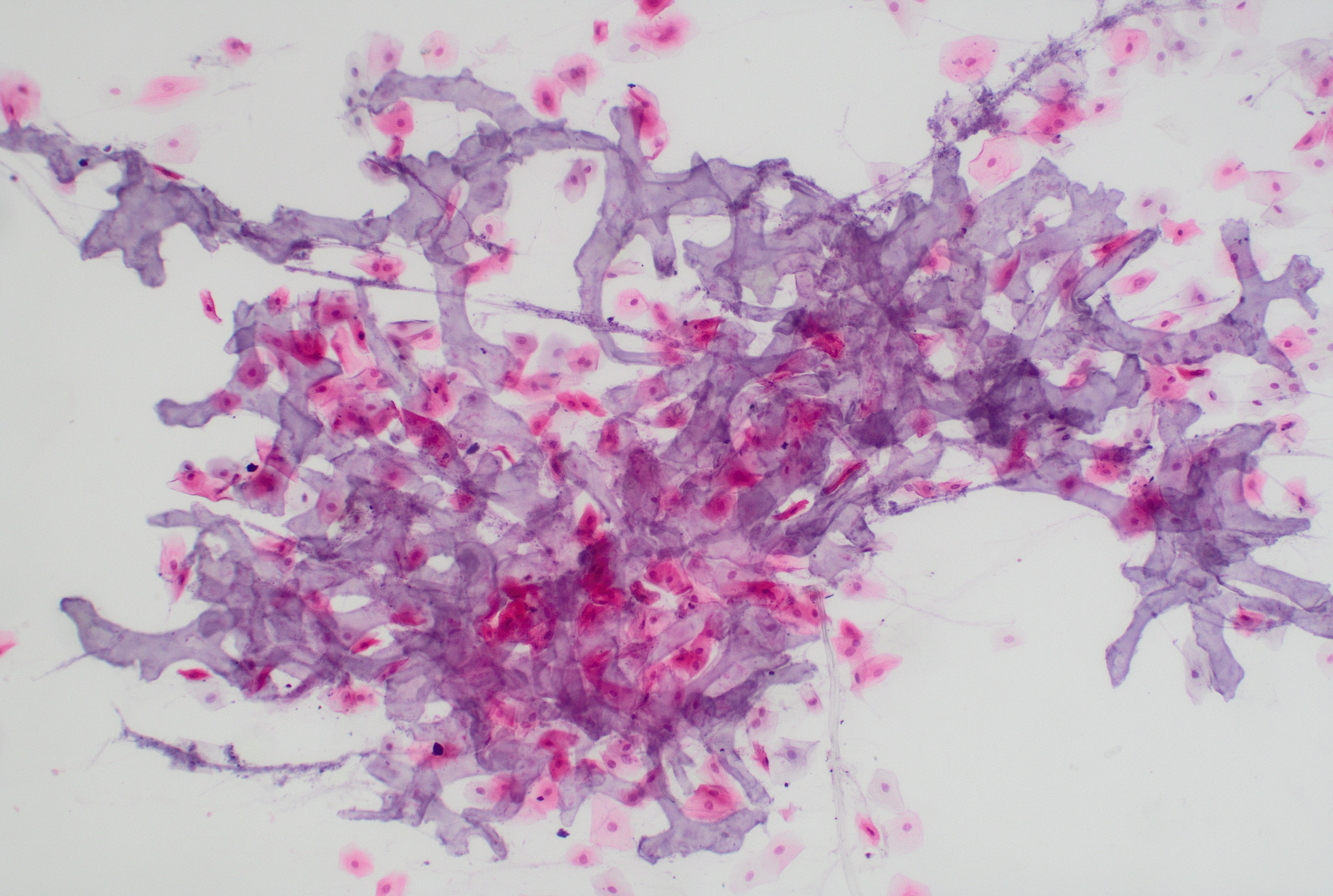 Hyaline pauciseptate mold with ribbon-like…
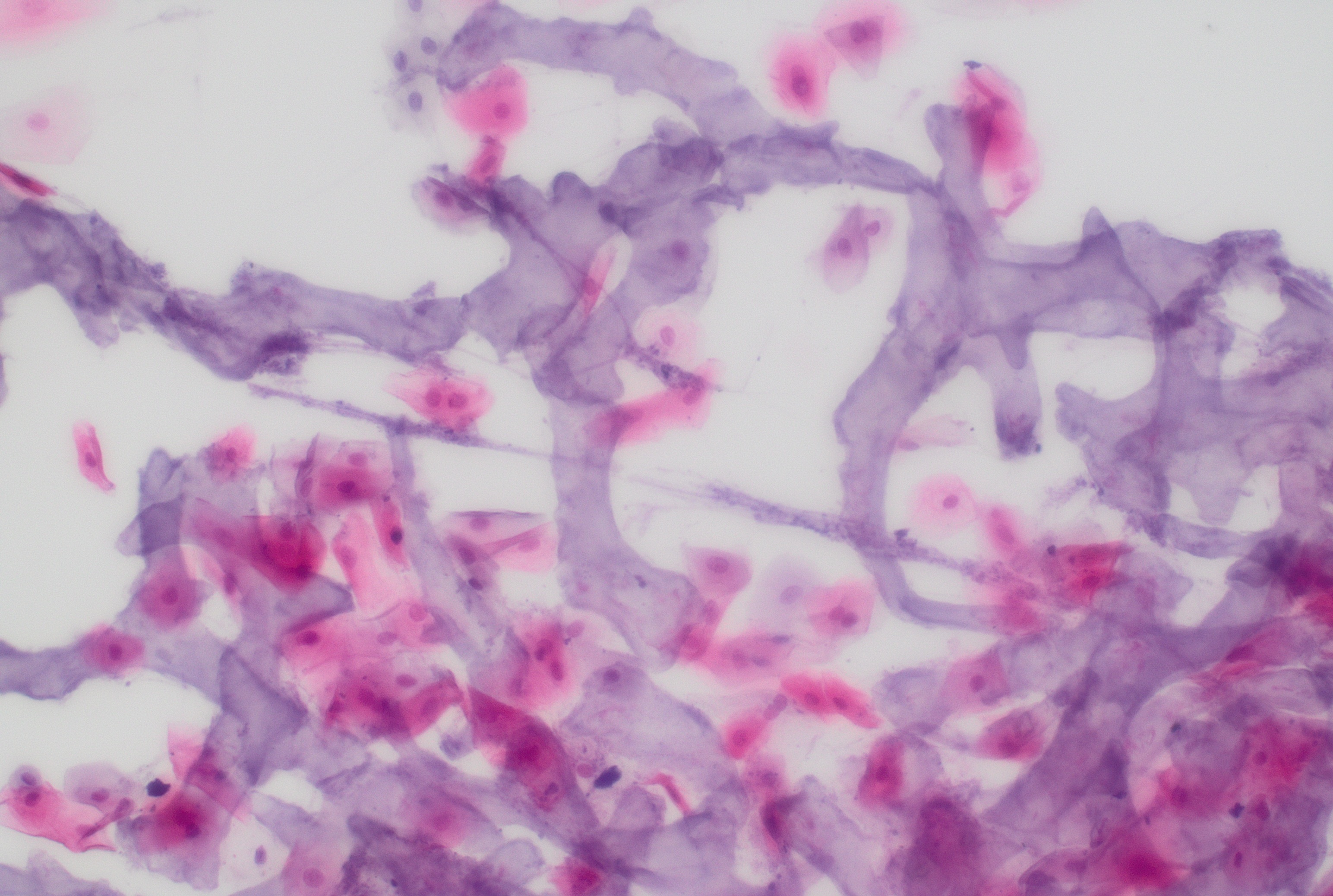 Higher magnification of hyaline pauciseptate…
Morphology
Cytology & Histology:
Hyaline (non-pigmented) pauciseptate molds with rare or no visible septa.
Common features of Mucormycosis:
- Broad hyaline, ribbon-like, irregular, thin-walled hyphae with usually right-angle branching at 90°; sometimes, acute-angle branching can be observed
- The diameter of hyphae is around 7-20 µm
- Due to processing and fungal fragility, the hyphae can appear fragmented, folded, or degenerated, and vary in width
- Rarely, especially in oxygenated areas (e.g. lung), conidia and arthroconidia can be seen
- Often, no or almost none visible septa
- A necroinflammatory background can be seen
Histologically, fungal elements are typically seen invading vessels, leading to thrombosis, necrosis, and hemorrhage. The most common features are angioinvasion, a prominent neutrophilic infiltrate, and hemorrhage; granulomatous response is occasionally seen. In severely immunosuppressed patients, the inflammatory infiltrate can be scant.
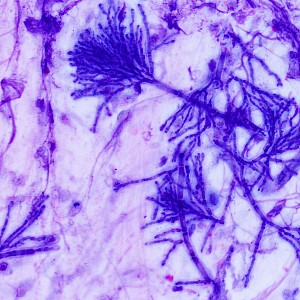
Hyaline septate and pauciseptate molds can sometimes show similar morphological characteristics and can be difficult to distinguish; therefore, identification through culture, PCR, or MALDI-TOF is necessary.
Special stains to highlight fungal hyphae:
PAS, PAS-D, GMS (may present with absent staining due to prior antimycotic therapy).
Differential Diagnosis:
Infection with hyaline septate molds, such as Aspergillus spp. and other genera of this group, or with Candida spp..
Clinical notes
The main routes of infection are inhalation of spores and entry through damaged skin.
Infections caused by this group of fungi are known as mucormycosis and are associated with a rapid course and high mortality.
Most common genera causing mucormycosis include Rhizopus, Mucor, Rhizomucor, Cunninghamella, Lichtheimia (formerly Absidia), and Saksenaea spp..
Major risk factors are immunosuppression, particularly in patients with hematologic malignancies, organ and stem cell transplant recipients, or uncontrolled diabetes mellitus, iron overload, and deferoxamine therapy (due to virulence factors and pathogenesis of infection). (1, 2)
Four main clinical presentations:
- Rhino-orbital-cerebral disease
- Pulmonary disease
- Primary cutaneous disease
- Disseminated disease
Less commonly, involvement of any other organ system is possible.
In severely immunocompromised patients, dual fungal infection can occur, most commonly with candidiasis.
Serum galactomannan and 1,3-beta-D-glucan tests are usually negative.
Ancillary Testing
PCR (serum, plasma, FFPE tissue); MALDI-TOF; Culture isolation (including tape prep with lactophenol blue), immunocytochemistryAdditional Information
Hyaline pauciseptate molds are found ubiquitously in the environment and include the phyla Mucormycota, Zoopagomycota, and the order of entomophthorales. They are found in the soil and are associated with decaying organic matter.
Differential Diagnosis
References
- Lax C, Pérez-Arques C, Navarro-Mendoza MI, et al. Genes, Pathways, and Mechanisms Involved in the Virulence of Mucorales. Genes (Basel). 2020;11(3):317.
- Gebremariam T, Lin L, Liu M, et al. Bicarbonate correction of ketoacidosis alters host-pathogen interactions and alleviates mucormycosis. J Clin Invest. 2016;126(6):2280-2294.